How Film Reviews Frame Gender: An NLP Study of Jennifer’s Body
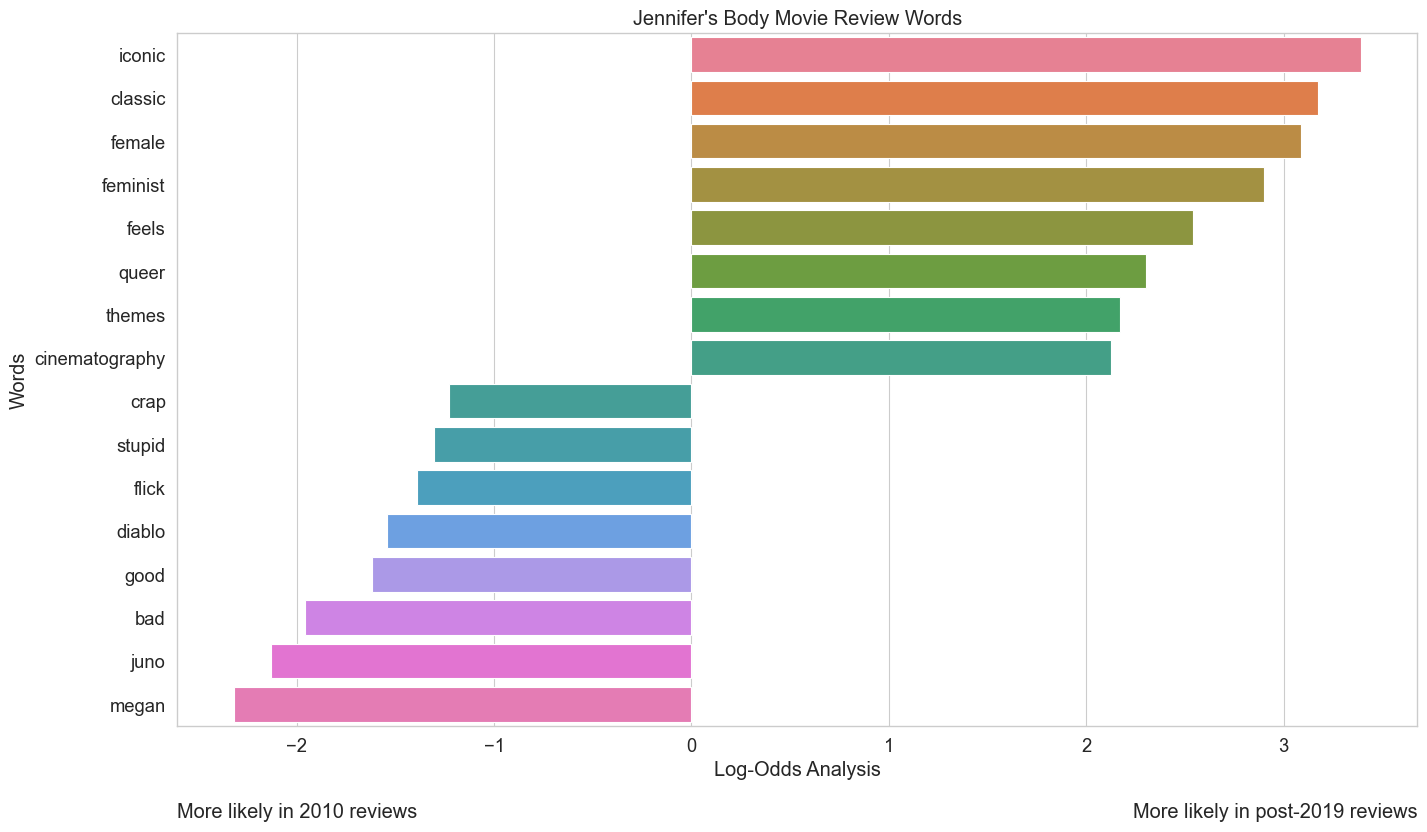
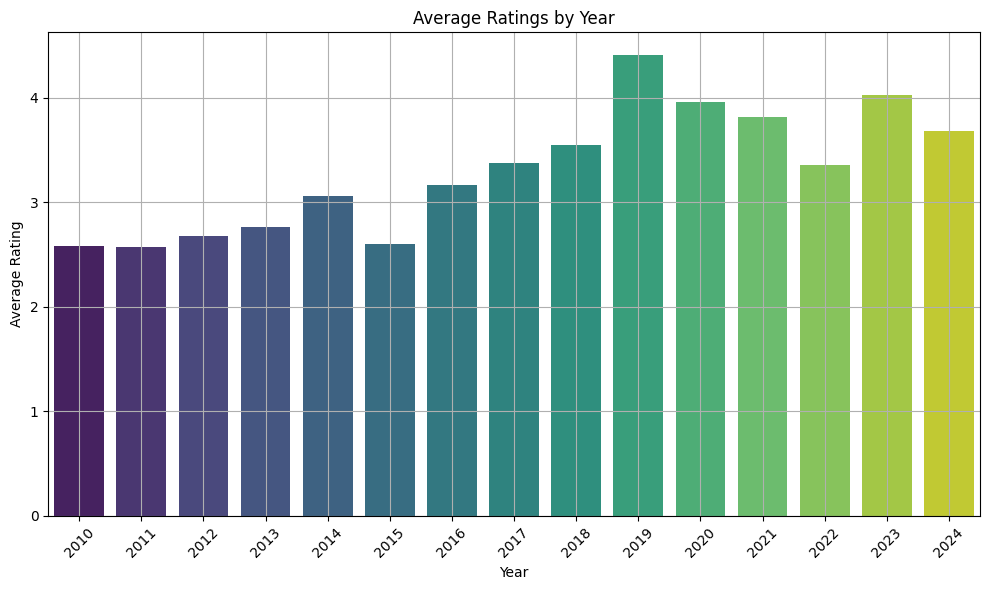
This project uses natural language processing to examine how cultural interpretations of Jennifer’s Body have shifted over time. Analyzing a decade of Rotten Tomatoes film reviews, I applied NLP techniques, including log-odds analysis, to compare review language from the film’s initial 2009–2010 reception to reviews written after 2019. Drawing on feminist film theory, the analysis reveals a marked shift from language rooted in the male gaze and objectification toward language emphasizing emotional depth, queer identity, and feminist reappraisal following the #MeToo movement.
Approach
Theory-informed modeling: Computational analysis was explicitly grounded in feminist film theory, operationalizing Laura Mulvey’s male gaze and Joey Soloway’s female gaze as analytic lenses rather than treating language patterns as neutral or purely statistical.
Cultural context awareness: The project situates NLP findings within broader socio-political shifts (e.g. #MeToo), recognizing that language reflects power, ideology, and historical moment.
Representation-centered metrics: Rather than focusing on performance or popularity, the analysis prioritizes how gender, sexuality, and embodiment are framed, demonstrating how NLP can surface inequities in cultural storytelling.
Results
Findings showed a clear post-2019 increase in language associated with empathy, emotional experience, queerness, and feminist interpretation, alongside a decline in appearance-focused, objectifying language.
To make these insights accessible beyond academic audiences, I translated the results into a video essay, using visual storytelling to communicate how computational methods can reveal cultural change in media criticism. Watch the full video here.